
Hiring a Tree Service in Stockbridge, Georgia
The straight answer
Hiring a tree service in Stockbridge goes best when the job is pinned down in writing before work starts: which trees, how they come down, who handles the city's paperwork for specimen or hazardous trees, what happens to the wood and stump, and when you pay. Georgia's Consumer Protection Division puts it simply: "Always insist on a contract for work to be performed, with all guarantees, warranties and promises in writing" (checked Nov 18, 2026).
TreeServiceStockbridgeGA.com is a referral site rather than a tree company. Whether you call (770) 954-8419 or use the form, the request lands with a single independent contractor serving Stockbridge and north Henry County. This guide is general information for any tree job here, whoever does it.
Who does tree work around Stockbridge
- Tree service companies. Crews with climbers, chainsaws, a chipper and often a bucket truck. They handle most residential removals, trimming and storm cleanup, and many grind stumps too.
- Arborists who consult. Some arborists assess trees and write reports without doing the cutting. That matters in Stockbridge, where the city's code asks for "a report from a professional arborist" before a dead, dying or hazardous tree comes down outside the five-tree yearly count (UDC Sec. 13.3.A.7). In McDonough, the Tree Removal Permit application has to be prepared by an arborist (Sec. 17.160.160).
- Crane services. Some tree companies own cranes; others rent a crane and operator for the day when a tree can't be lowered any other way.
- Stump grinding operators. Small outfits that only grind stumps, often after another crew has done the removal.
- Land-clearing companies. Larger machines for lots and acreage. On a tract over five acres outside a subdivision, Henry County's tree protection section applies (ULDC Sec. 5.03.02.A.3).
- Utility line-clearance crews. The crews trimming along the power lines work for Georgia Power or the co-op on the utility's schedule, not for homeowners. Georgia Power says it does "not schedule individual pruning requests" (Georgia Power, checked Nov 18, 2026).
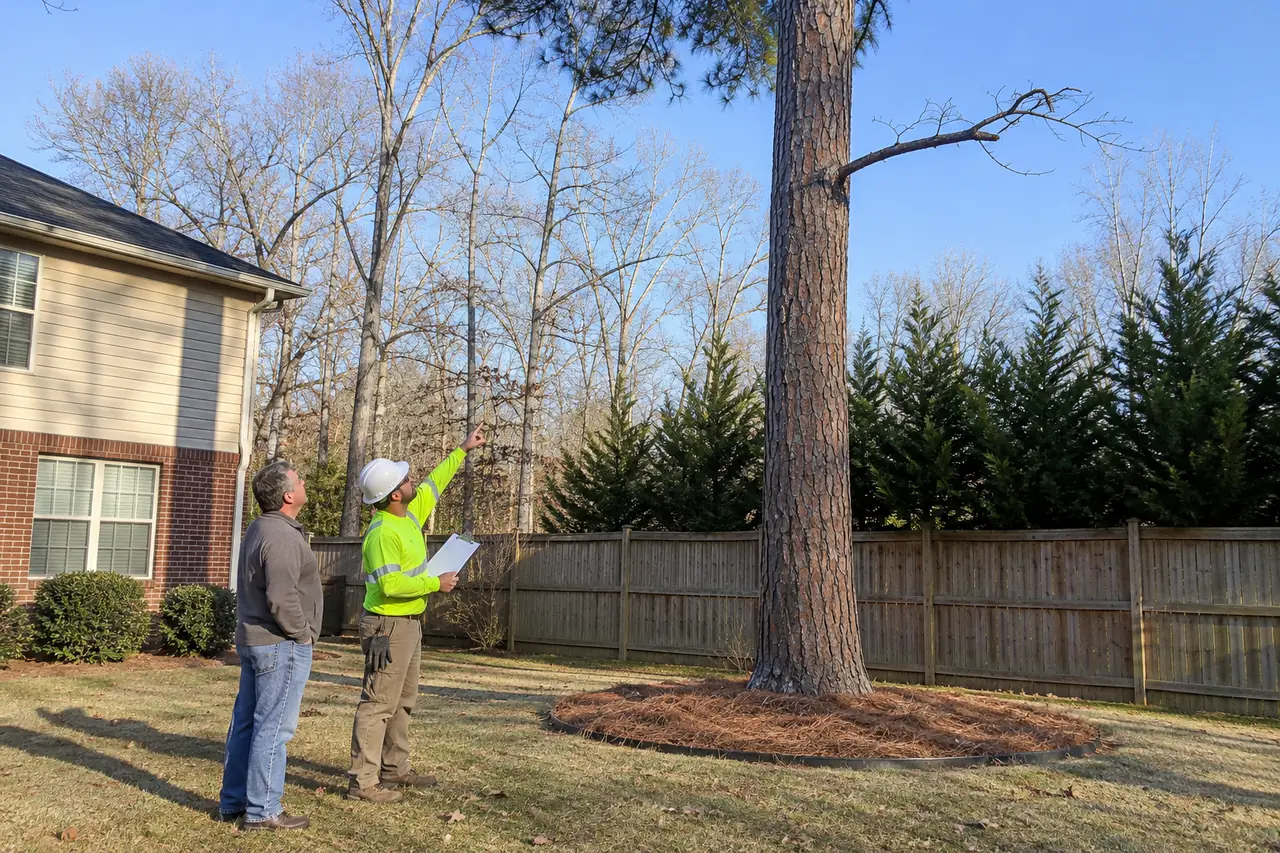
What a tree job involves, start to finish
- The look. The contractor walks the tree: trunk, lean, roots, dead wood, and everything within reach if it falls.
- The rules check. Inside Stockbridge: how many trees this year, specimen size, dead or hazardous. In McDonough: is it a protected tree. Near wires: is the utility needed first.
- The written price. Scope, method, cleanup and payment terms on paper.
- Preparation. Georgia 811 for any grinding or digging, the utility for lines, the arborist's report or permit where the code calls for one.
- The work. Felling or sectional take-down, rigging or a crane, chipping, cutting wood to length.
- Cleanup and the walk-through. Brush and wood handled as agreed, ruts raked, the stump ground if it's in the job. You check the yard before the last payment.
Questions to ask about your tree
- Is my lot inside Stockbridge's city limits, in McDonough, or in unincorporated Henry County?
- How big is the trunk at 4.5 feet up, and does that make it a specimen tree under the city's code?
- If the tree is dead or dangerous, who writes the arborist's report for the Director, and is it in the price?
- How will the tree come down: felled whole, lowered in sections, or with a crane? Where does the truck or crane park?
- What will you do to protect the lawn, the driveway and the septic area if the ground is wet?
- Is the stump in the price? Who files the Georgia 811 request?
- What happens to the trunk wood and the brush? Will anything be left behind?
- Does the power company need to trim, disconnect or cover a line first?
- What day is the work planned for, and what if rain delays it?
What the written contract should say
A good contract for tree work in Stockbridge reads like a checklist:
- the address, and which trees by location and kind ("the 28-inch white oak at the back left fence");
- the work on each: remove, trim, grind;
- the method if it matters to you, especially a crane or work over the house;
- the cleanup: chipped brush, wood cut to length or hauled, stump grinding depth, chips raked or removed;
- who handles 811, the utility and any city paperwork;
- the total price, the deposit, and the date the rest is owed;
- the start date or window, and what happens if it slips;
- every promise the salesperson made out loud.
The Consumer Protection Division also warns against anyone who refuses to provide a written contract (storms and fraud page, checked Nov 18, 2026).
Deposits and paying
The same page gives Georgia's guidance on money: "Never pay for the entire project before the work begins," put down no more than a third of the total up front, save the final payment for after the work is done, and steer clear of contractors who only accept cash. For tree work, that means:
- a deposit, if one is asked, that is a modest share of the price, with a receipt;
- the balance due after you've walked the yard and the cleanup matches the contract;
- a payment method that leaves a record, such as a check or card.
After a storm
Georgia's Consumer Protection Division advises avoiding door-to-door offers for home repair work and asking friends and neighbors instead. A Georgia law known as SB 201 covers contracts signed within one year of a natural disaster to repair, replace or mitigate the disaster's damage to a home. Under the part that took effect July 1, 2025, the division's page says, the contractor may not fail to substantially start the work within a year of signing, do substandard work, or take an assignment of your insurance proceeds, and you can cancel before midnight on the fifth business day after your insurer tells you in writing that the loss isn't covered. Fraud reports go to the division at (404) 651-8600 or 1-800-869-1123 (storms and fraud page, checked Nov 18, 2026). The storm page covers photographing damage for a homeowner's insurance claim before the cleanup.
How this site fits in
This site doesn't do tree work, set prices or sign contracts. A phone call or a form request is handed to a single independent contractor working in the area, who visits the tree and names a price. If you say yes, the job runs under an agreement between the two of you. The disclosures page says more about how the site works.