
Tree Removal in Stockbridge, Georgia
The straight answer
Tree removal in Stockbridge starts with two checks: is the lot inside the city limits, and is the tree a specimen? Inside the city, up to five ordinary trees a calendar year can come off a single-family property without the city's approval, but a specimen tree (a sound oak, tulip poplar or pine 30 inches across or more) and a dead or hazardous tree taken down outside that count come with extra steps under Title 13 of the Unified Development Code (checked Nov 18, 2026).
Call (770) 954-8419 and one independent contractor who works in Stockbridge comes out, looks at the tree and what's under it, explains how it would come down and gives you a price.
Three questions to settle before the saw
- City, county or McDonough? The Stockbridge rule applies to "all real property in the City of Stockbridge City limits" (UDC Sec. 13.2.A). A Stockbridge mailing address outside those limits falls under Henry County's code, and McDonough has a permit rule of its own.
- How many trees this year? Section 13.3.A.1 exempts "five (5) or fewer trees, other than specimen trees" on a single-family property "within a single calendar year." More than that needs the Director's approval under Section 13.3.A.2.
- Is it dead, dying or hazardous? Then Section 13.3.A.7 lets it come down outside the five-tree count, but asks for a professional arborist's report to the Director before removal, unless the danger is immediate.
Each of those is quoted in full, with the penalties, on the Stockbridge tree rules page.
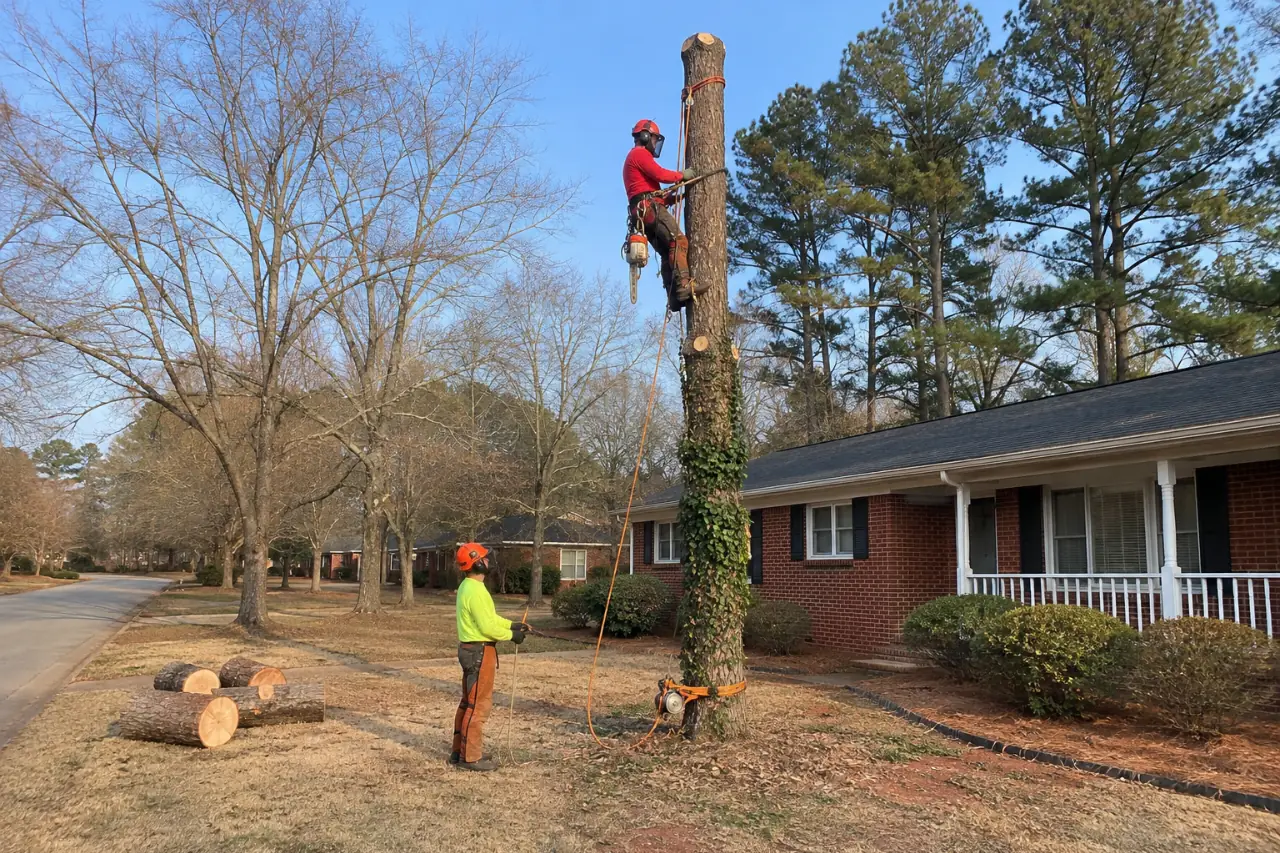
Measure the trunk before anyone prices the job
The specimen sizes in Section 13.6.H.2 are trunk diameters at breast height, or DBH, and Stockbridge's code says where to measure: "four and one half (4½) feet above ground level on the uphill side of the tree" (Sec. 13.4). If the tree splits into more than one trunk below that height, each trunk is measured individually toward the total. Wrap a tape around the trunk at that spot and divide the reading by 3.14 to get the diameter, the conversion the City of Tucker's DBH guide uses (checked Nov 18, 2026).
| Tape reading around the trunk | Diameter (DBH) | What it means in Stockbridge |
|---|---|---|
| 31.4 inches or more | 10 inches or more | Specimen size for a dogwood, redbud or sourwood |
| Under 94.2 inches | Under 30 inches | Below specimen size for an oak, hickory, tulip poplar or pine |
| 94.2 inches or more | 30 inches or more | Specimen size for an oak, hickory, tulip poplar or pine |
A tree has to be in "fair or better condition" to count, under Section 13.6.H.3, and the Director identifies specimen trees. A hollow or badly decayed giant may not qualify; a sound, healthy 30-inch white oak is the kind of tree the section describes. If the tape says specimen, call the city before booking the removal, because a removed specimen tree is replaced at 1.5 times its diameter in new trees (Sec. 13.6.H.6).
Getting a big tree down beside a Stockbridge house
The city's comprehensive plan, Shaping Stockbridge Together for 2038, says about 53% of the city's housing units had been built since 2000, much of it in subdivisions (checked Nov 18, 2026). On a subdivision lot, what stands within reach of the tree (the house, a fence, a shed, the neighbor's yard) shapes the method more than the tree's height does.
Felled in one piece
Where there's a clear drop zone longer than the tree is tall, a climber or groundworker can notch and fell it whole. It's the quickest method and usually the least expensive, but it needs open ground, often more than a backyard has.
Taken down in sections
Over a roof, a pool or a fence, the crew climbs or uses a bucket truck, cuts limbs and trunk sections a piece at a time, and lowers each one on ropes. This is slower, and the price reflects the extra hours and rigging.
With a crane
When there's no room to lower sections, or the tree is too weak to climb safely, a crane lifts pieces over the house to the street. HomeGuide's figure for crane help is $500 to $2,500 per day, billed in addition to the removal (HomeGuide, checked Nov 18, 2026). Ask where the crane would set up and whether the street, the driveway or a neighbor's yard is involved.
Soft ground
Red clay subsoil is typical of the Georgia Piedmont. The Cecil series, a Piedmont upland soil that USDA lists as large in extent, has a subsoil described as "red (10R 4/8) clay" (NRCS Official Series Description, checked Nov 18, 2026). After a wet week, heavy trucks and loaders can rut that ground. It's fair to ask what the crew lays down to protect the lawn and when they'd rather wait for the yard to dry.
The trees that usually come down here
The same USDA description lists the trees that grow in wooded areas on these soils: "loblolly pine, Virginia pine, red oak, white oak, post oak, hickory, blackgum, maple, and dogwood." Stockbridge's own code names tulip poplars among its large hardwoods and lists sweetgum, for limited use, among its replanting trees. Price ranges published for the two biggest groups:
- Pines: $200 to $1,600 on average, and $2,000 to $3,000 for pines 100 feet or taller.
- Oaks: $250 to $2,500 on average, and $3,000 to $6,000 for mature oaks.
National ranges from HomeGuide, checked Nov 18, 2026. Atlanta-area removal runs $330 to $2,250 per tree on the same page. More on the cost page.
Pines that turn yellow or rust-colored from the top down are a separate story, often bark beetles. See pine bark beetles before deciding a fading pine can wait.
Wood, brush and the stump
A removal leaves three piles of decisions. Brush is usually chipped on site. Trunk wood can be hauled, cut to firewood length or left in rounds; HomeGuide prices a dump-trip haul at $75 to $250 and log splitting at $50 to $100 hourly. The stump is a separate job unless the price says otherwise; see stump grinding.
Burning the brush yourself is limited. From May 1 to September 30, Georgia EPD bans burning yard and land-clearing debris in Henry County and 53 other counties (EPD, checked Nov 18, 2026). The rest of the year, hand-piled leaves and limbs can be burned without a permit between sunrise and sunset, at least 25 feet from woods and 50 feet from buildings, with someone watching until it's out (Georgia Forestry Commission, checked Nov 18, 2026).
Removals that start with a call to the power company
Georgia Power's own FAQ says "Substantial tree work, including tree removals and limb removals, is the responsibility of the property owner," and that "No one should climb trees that are in the vicinity of power lines" (Georgia Power, checked Nov 18, 2026). Snapping Shoals EMC says that in most cases it disconnects service while a member's contractor removes a tree near the line and reconnects it afterward (SSEMC, checked Nov 18, 2026). The power line page has the state's 10-foot rule.
Tree removal questions from Stockbridge homeowners
The tree is dead. Can I just have it cut?
Inside the city, a dead tree that threatens people or property can come down without using up the five-tree count, but Section 13.3.A.7 asks for a professional arborist's report to the Director first, unless the danger is immediate.
Does a removal need a building permit?
Not by itself in anything we read. Tree work tied to grading for an addition, pool or driveway travels with that project's permits under Section 13.5.D.
Can the wood be left for firewood?
Usually, if you say so before the job is priced; cutting rounds to length and stacking them takes time that hauling doesn't.
Who decides how the tree comes down?
The contractor, after seeing it. Ask them to explain the plan in plain words and to put the method and the cleanup in the written price.