
Stump Grinding in Stockbridge, Georgia
The straight answer
Stump grinding near Stockbridge runs about $120 to $400 for a single stump plus $30 to $60 for every extra one, or $2 to $6 per inch across, on HomeGuide's national figures (checked Nov 18, 2026). Before the grinder touches the ground, Georgia 811 marks buried gas, power, water and cable lines; the 811 center doesn't charge homeowners for the request.
Call (770) 954-8419 and one independent contractor who works in Stockbridge comes to measure the stump, check what's buried near it and price the grinding.
Georgia 811 comes first
A stump grinder chews several inches below grade and throws roots out sideways, which is exactly where service lines to a house run. Georgia 811's homeowner FAQ lists "Removing tree roots" among the projects to call about, and says the center doesn't charge to mark lines or to take the call (Georgia 811 FAQ, checked Nov 18, 2026).
- How to reach it: dial 811 or 1-800-282-7411, or use the homeowner eRequest online.
- How far ahead: the FAQ gives homeowners a window of "at least 48 hours but no more than 10 working days, excluding weekends and legal holidays," and in another answer asks for tickets "at least 3 business days prior to work beginning." Plan on three business days and you satisfy both.
- What the marks mean: the tolerance zone is 18 inches on either side of the outer edge of a marked line. Treat that strip as off-limits to the grinder wheel until everyone knows exactly where the line runs.
Settle who places the request. If the contractor files the ticket, ask for the ticket number before grinding day.
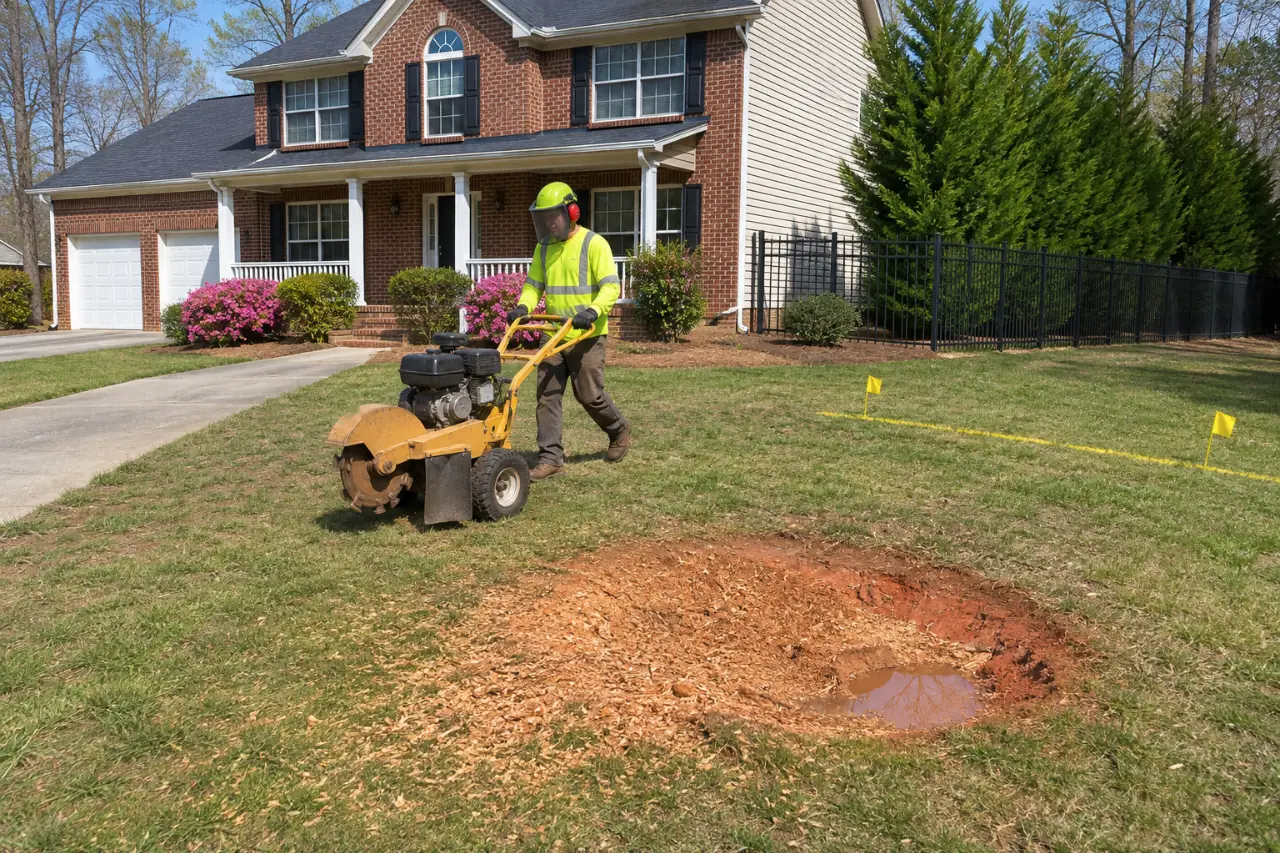
What grinding into Stockbridge's red clay looks like
Red clay subsoil is typical of the Georgia Piedmont. USDA describes the subsoil of the Cecil series, a Piedmont upland soil it lists as large in extent, as "red (10R 4/8) clay" with bedrock more than 60 inches down, and the Pacolet series, also large in extent across the Piedmont, as red clay on slopes that "commonly are 15 to 25 percent" (Cecil and Pacolet descriptions, checked Nov 18, 2026). Here's what that means at the stump:
- The grindings come out orange-brown, a mix of wood chips and clay rather than clean mulch.
- The hole holds water. Dense clay drains slowly, so a ground-out bowl can puddle after rain until it's filled and crowned with topsoil.
- The chips settle. As wood in the hole breaks down, the spot sinks. Plan to top it up after a season.
- Slopes change the setup. On a steep backyard, the grinder has to sit level enough to work, which can mean extra time or a smaller machine.
Per-inch pricing, worked out
HomeGuide lists stump grinding at $2 to $6 per inch of diameter, measured across the base of the trunk rather than just the cut face, with minimum service fees of $80 to $160 (HomeGuide, checked Nov 18, 2026). Run those numbers on stumps you'd find in Stockbridge yards:
| Stump across the base | At $2 to $6 per inch | Likely bill |
|---|---|---|
| 12-inch dogwood or small pine | $24 to $72 | The $80 to $160 minimum |
| 24-inch loblolly pine | $48 to $144 | The $80 to $160 minimum |
| 36-inch oak | $72 to $216 | $80 to $216 |
| 48-inch old oak or poplar | $96 to $288 | $96 to $288; HomeGuide puts extra-large stumps at $300 to $800 |
Those are arithmetic on national rates, not quotes. A stump on a slope, behind a narrow gate, wrapped around a fence post or sitting on a marked line takes longer and costs more. The same HomeGuide page puts the first stump at $120 to $400 and each extra one at $30 to $60, which is why grinding every stump in one visit makes sense.
Grinding, digging out, or leaving the stump
- Grinding takes the stump and the main surface roots down several inches. Lawn, a flower bed or a fence line can go back over it once the hole is filled.
- Digging out pulls the stump and root ball. HomeGuide lists digging up a stump at $80 to $190 each, a $150 to $350 minimum to bring a backhoe, and root removal at $75 to $150 an hour. It leaves a bigger hole in the clay, and makes the most sense where a footing, a slab or a driveway is going in.
- Leaving it is the cheapest choice up front. A stump cut low can sit for years, though it's a mower hazard and a trip hazard in the meantime.
The chips and the cleanup
Grinding a large oak stump fills a wheelbarrow many times over. Decide before the job whether the chips stay as mulch, get raked back into the hole, or get hauled away, and whether the price includes topsoil and seed. If you want the area level for sod, say so; a crowned fill that settles over a season is easier to fix than a dip.
Stump grinding by itself doesn't count against Stockbridge's five-tree allowance. That allowance is about removing trees, and the tree is already gone. The city rules page has the details.
Stump grinding questions from Stockbridge homeowners
How deep does the grinder go?
Enough to get below the grass and the main surface roots. If you're planting a tree or setting a post in the same spot, ask for a deeper grind and say why.
Can a stump be ground right after a storm removal?
Yes, once 811 has marked the yard. A tree that fell and lifted its root plate is a different job; the root mass may need to be cut apart, set back or hauled.
Will the roots keep sprouting?
Some hardwoods send up shoots from remaining roots for a season or two. Mowing them down as they appear is the usual answer.
Who calls 811, me or the contractor?
Either can. Agree on it in writing, and get the ticket number.