
Trees Near Power Lines in Stockbridge, Georgia
The straight answer
A tree touching or leaning toward a power line in Stockbridge is a job for the electric company first: Georgia Power, Central Georgia EMC or Snapping Shoals EMC, whichever sends your bill. Georgia's High-Voltage Safety Act keeps a tree crew's work within 10 feet of an overhead line carrying more than 750 volts on hold until the line's owner has been notified through 811 at least 72 hours ahead, weekends and holidays excluded, and safeguards are in place (Utilities Protection Center brochure, checked Nov 18, 2026).
Once the line is dealt with, call (770) 954-8419 and one independent contractor who works in Stockbridge prices the tree work that's left.
Three electric providers serve Henry County
The Henry County Development Authority lists three electric suppliers: Central Georgia EMC, whose 14-county area includes Henry; Snapping Shoals EMC, whose territory "covers parts of Rockdale, Henry, Newton" and other counties; and Georgia Power (Henry County partners page, checked Nov 18, 2026). Snapping Shoals says it serves about 100,000 homes, businesses and other facilities across eight counties, including large portions of Henry (SSEMC, checked Nov 18, 2026).
Which one serves your street is printed on your bill. It matters, because each one handles trees on its own schedule and terms.
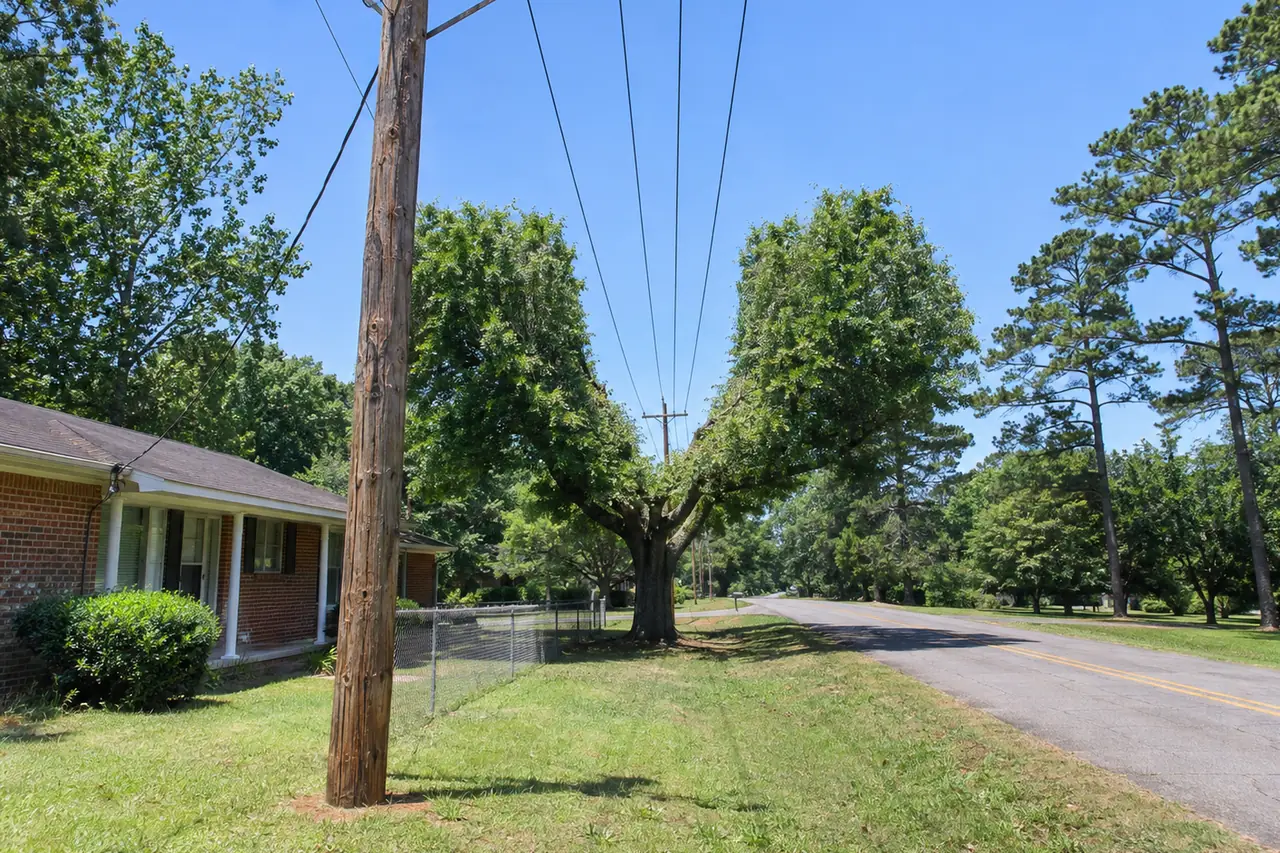
The 10-foot law and the 72-hour notice
The Utilities Protection Center's brochure on the High-Voltage Safety Act, posted by Georgia Power, sets out the rule (High-Voltage Safety Act brochure, checked Nov 18, 2026):
- It covers work done as part of a trade or business, a tree crew's included, "within 10 feet of high voltage lines," meaning overhead lines carrying more than 750 volts.
- The person doing the work notifies the Utilities Protection Center, by calling 811, "at least 72 hours (excluding weekends and holidays)" before starting.
- No work starts in that zone until the line's owner has arranged safeguards, such as de-energizing, moving or shielding the line.
- Breaking the rule is a misdemeanor: $1,000 the first time, $3,000 each time after, and the person who broke it is strictly liable for any damage or injury that follows.
Ten feet is closer than it looks from the ground. A pole saw raised by someone on a ladder, or a limb swinging on a rope, covers that distance fast. Snapping Shoals tells members plainly about trees near lines: "do not attempt to handle them yourselves" (SSEMC, checked Nov 18, 2026).
What each utility trims, and what it leaves to you
Georgia Power
Georgia Power prunes whole lines on a planned cycle and says it does "not schedule individual pruning requests" (Georgia Power trees page, checked Nov 18, 2026). Around the service wire to a house, it prunes "on a limited basis" when it learns of a problem through inspection or a customer call. Its FAQ is direct about the rest: "Substantial tree work, including tree removals and limb removals, is the responsibility of the property owner," and "No one should climb trees that are in the vicinity of power lines" (Georgia Power FAQ, checked Nov 18, 2026).
Snapping Shoals EMC
The co-op trims overhead lines on a "4 to 5 year cycle," inspects service lines during trimming and removes limbs that are in "hard" contact with them. When a member's own contractor takes down a tree near the line, Snapping Shoals says that in most cases it disconnects the service and reconnects it after the work (SSEMC right-of-way page, checked Nov 18, 2026).
Central Georgia EMC
The co-op asks members to "contact customer service at 770-775-7857 to report a dead or dangerous tree near the ROW area" (CGEMC, checked Nov 18, 2026).
Street lines versus the wire to your house
The lines strung pole to pole along the street feed the whole neighborhood, and the utility clears them on its cycle. The service drop runs from the last pole to the meter on your house, often across the yard and close to the trees in it. The wire belongs to the utility; the tree belongs to you. In practice:
- Limbs rubbing the service drop: call the utility first and ask what it will prune.
- A tree to be removed that could hit the drop: ask the utility about a temporary disconnect, then schedule the tree crew for after it.
- A limb already lying on the drop or a street line: stay clear and call the utility. That's not tree work yet.
Taking down a tree that leans toward the lines
The usual order for a Stockbridge removal near the wires:
- Call the utility that serves you and describe the tree and how close it is.
- File the 811 notice at least 72 hours ahead, not counting weekends and holidays, if any part of the work comes within 10 feet of a high-voltage line.
- Let the utility do its part: trim back, disconnect the drop, or cover the line.
- Then the contractor takes the tree down, pulling sections away from the lines.
Inside the city limits, the city's tree rule still applies to the removal itself: the five-tree yearly allowance, specimen sizes, and the arborist's report for a hazardous tree. See Stockbridge tree rules.
Replanting away from the wires
Georgia Power's "Right Tree, Right Place" guide sorts planting into zones (guide, checked Nov 18, 2026):
- next to a utility right-of-way, species that "will not exceed 25 feet in height";
- a step farther out, trees of 40 feet or less;
- "Higher trees could be used in any location 50 feet or more from power lines";
- big trees near the house at least 35 feet from it.
It names Chinese redbud, Japanese camellia and highbush blueberry among small choices, and says "Do not plant directly under overhead lines." If you aren't sure whether a high-voltage line runs along the right-of-way next to your property, the guide says a Georgia Power representative can help and gives its Forestry and Right of Way Services department at 1-877-276-0578.
When a storm brings a line down
Assume the line is energized and keep everyone, pets included, well away from it and from anything it touches, including a wet fence or the tree itself. Report it to the utility or 911. After the line is safe, the tree cleanup can start; the storm page covers the rest.
Power line questions from Stockbridge homeowners
Will the power company cut down my tree if it's near the line?
Georgia Power says removals are the property owner's responsibility. The co-ops handle limbs in contact with their lines and will talk through the rest; call yours.
Does the 72-hour notice apply to the wire to my house?
The act covers overhead lines carrying more than 750 volts. The utility can tell you which of the lines near your tree that includes; Georgia Power customers can ask its Forestry and Right of Way Services department at 1-877-276-0578. Snapping Shoals goes further and tells its members that "any work within 10 feet of overhead lines must be reported" through the Utilities Protection Center 72 hours before the work (SSEMC, checked Nov 18, 2026), so the safe course is to call 811 whenever work comes within 10 feet of any overhead line.
Can I trim the small branches near the line myself?
Georgia Power's planting guide says you "should not attempt to trim any vegetation growing near or on any overhead power lines." Call the utility.
Does the utility charge to disconnect service for tree work?
Ask yours. Snapping Shoals describes the disconnect and reconnect as its usual practice for a member's tree removal.