
Stockbridge, GA Tree Permit Rules for Homeowners
The straight answer
Yes, Stockbridge has a tree rule that reaches ordinary house lots. Under Title 13 of the city's Unified Development Code, a homeowner may remove five or fewer trees in a calendar year from a single-family property without the city's approval, as long as none is a specimen tree. A dead, dying or hazardous tree can come down outside that count, but the owner first sends the city's Director a professional arborist's report, unless the danger is immediate (Secs. 13.3.A.1 and 13.3.A.7, checked Nov 18, 2026).
A specimen tree is one in fair or better condition that measures at least 30 inches in trunk diameter for oaks, hickories, tulip poplars and pines, or 10 inches for dogwoods, redbuds and sourwoods, and the code lets a smaller tree count too (Secs. 13.6.H.2 to 13.6.H.4). The rule covers lots inside the Stockbridge city limits only.
Text read from the city's own posting of the City of Stockbridge Unified Development Code, Title 13, Tree Protection (adopted March 14, 2022; Title 13 starts on page 281 of the PDF), checked Nov 18, 2026. Section numbers below are the code's own.
Does Title 13 reach your lot?
Section 13.2.A says the tree protection rules "shall apply to all real property in the City of Stockbridge City limits." That is the test: the city limits, not the post office. Plenty of homes with a Stockbridge mailing address sit in unincorporated Henry County, where the county's code applies instead, and farther south McDonough has its own, stricter chapter. If you aren't sure which side of the line your lot is on, the city's Community Development Department can tell you before any tree work is booked.
- Inside the city: this page.
- Outside any city, in Henry County: Henry County tree rules.
- Inside McDonough: McDonough's 2025 canopy chapter.
The five-tree allowance, word for word
Section 13.3.A.1 exempts "The removal of five (5) or fewer trees, other than specimen trees, on any single-family residential property, within a single calendar year." Four things in that sentence matter in practice:
- It counts trees, not jobs. Five trees taken down in one visit use up the year's allowance the same as five visits would.
- The year is the calendar year. A tree removed in December and one removed in January fall in different years.
- It's for single-family residential property. Apartment sites and commercial lots aren't what this exemption describes; a townhome owner should ask the city how it reads the word for their lot.
- Specimen trees are carved out. A specimen tree doesn't become exempt just because it's the only tree coming down that year.
A sixth tree, or more
Section 13.3.A.2 lets the Director approve removing more than five trees, other than specimen trees, from an owner-occupied, single-family lot when the owner must remove them for one of three reasons: to build a newly permitted structure; to build an addition to or improve an existing structure where the tree is a physical detriment to it; or to improve the health of other trees in the landscape. The approval comes from the Director, so ask before the sixth tree is cut, not after.
Specimen trees: the sizes and the condition test
Section 13.6.H.2 defines a specimen tree as any tree in fair or better condition that equals or exceeds these trunk diameters at breast height (DBH):
| Group in the code | Examples named | Specimen at | About this far around the trunk |
|---|---|---|---|
| Large hardwoods | Oaks, hickories, tulip poplars and similar | 30 inches DBH | 94.2 inches (about 7 ft 10 in) |
| Large softwoods | Pines, evergreens and similar | 30 inches DBH | 94.2 inches (about 7 ft 10 in) |
| Small trees | Dogwoods, redbuds, sourwoods and similar | 10 inches DBH | 31.4 inches (about 2 ft 7 in) |
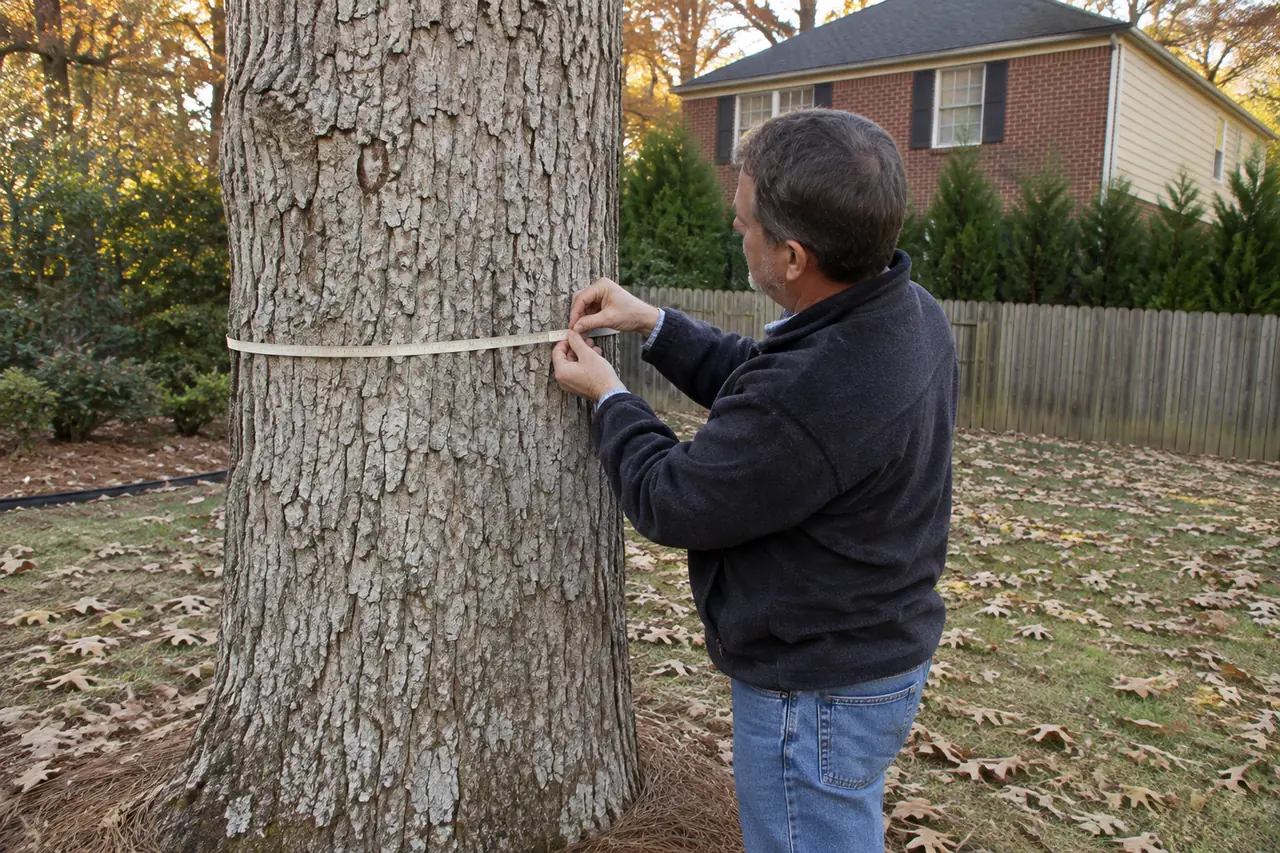
Section 13.4 says DBH is measured "four and one half (4½) feet above ground level on the uphill side of the tree." When a tree splits into more than one trunk below that height, each trunk is measured individually toward the tree's total DBH; for crepe myrtles only the largest trunk counts. Circumference figures in the table are the diameter times pi (3.1416). To go the other way, divide the tape reading by 3.14, as the City of Tucker's DBH guide explains (checked Nov 18, 2026).
Size alone doesn't make a specimen. Section 13.6.H.3 sets the minimum standards for "fair or better condition":
- "A life expectancy of greater than fifteen (15) years."
- "A relatively sound and solid trunk with no extensive decay or hollow, and less than twenty (20) percent radial trunk dieback."
- "No major insect or pathological problem."
A big oak with a hollow trunk, or a 32-inch pine full of beetles, may fail that test. Section 13.6.H.4 runs the other way: a smaller tree can still count as a specimen if it is a rare or unusual species, of historical significance, used as a focal point in a landscape, or of exceptional aesthetic quality. Section 13.6.H.1 says specimen trees "shall be identified by the Director, or his/her designee," so the city, not the homeowner or the tree crew, has the last word.
Replacing a specimen tree
Section 13.6.H.6 says "Any specimen tree removed from a parcel shall be replaced by one and five-tenths (1.5) times the equivalent inches (DBH)," using replacement trees or existing trees beyond what the code otherwise requires. Worked through: taking out a 32-inch specimen oak calls for 48 inches of trunk diameter in replacement trees, for example twelve 4-inch trees. Title 13 doesn't lay out a separate homeowner application for removing a specimen tree in the text we read, which is the strongest reason to call the Director's office before one comes down.
Dead, dying or hazardous trees: the arborist's report
Section 13.3.A.7 exempts "The removal of any Dead, Dying, or Hazardous (DDH) tree which has become, or threatens to become, a danger to human life or property," and then sets the condition:
"The owner/developer, prior to removal of the DDH tree(s), shall provide a report from a professional arborist to the Director prior to tree removal. This report shall identify the conditions of the tree(s) that necessitate removal."
So a dead pine leaning toward the house can come down without using up the five-tree count, but it isn't automatic: the report goes to the Director first, and it has to say what is wrong with the tree. Ask the contractor whether they write that report themselves or work with an arborist who does, and whether its cost is in the price.
When the danger is immediate
The same section adds: "However, in the case of immediate danger to life and property the tree may be taken down and an inspection requested to verify the condition of the tree." A trunk split and resting on the roof after a storm is the kind of case that clause describes. Take photos of the tree and the damage before and during the work, keep the wood or stump until the city has had its look if you can, and request the inspection afterward.
Diseased or insect-infested trees
Section 13.3.A.4 exempts "The removal of trees found to be diseased, or insect infested" by the county extension service, the state forestry commission, an arborist or an urban forester. For a pine dying from bark beetles, that means getting the infestation identified by one of those reviewers before the tree comes down. The pine bark beetle page describes the signs the Georgia Forestry Commission lists.
Trees by a creek or in the floodplain
Section 13.6.E says nothing in the tree rules "shall be construed to allow the removal of any tree or vegetation in a required stream buffer, transitional buffer zone or state buffer zone except buffer improvements as authorized by the Director." Section 13.6.J is stricter about low ground: trees "shall not be cut or removed from the floodplain," apart from three cases: a tree found diseased or insect-infested (by the county extension service, the Georgia Forestry Commission, an arborist or a forester), with a professional arborist's report sent to the Director before removal; public road, utility or stormwater work; and an approved wetland mitigation plan. If the tree stands near a creek or in a flood-prone corner of the lot, ask Community Development before it's cut, even when it would otherwise fit inside the five-tree allowance.
The penalties written into Title 13
Section 13.10 makes the Director responsible for enforcement and says a violator may be punished by "a fine not to exceed one thousand dollars ($1,000.00)," by up to 60 days in the city jail, or both. It adds: "Each tree removed, damaged or killed in violation of this section shall be considered a separate offense," and each day of non-compliance is a separate offense too. Trees 8 inches DBH or larger removed in violation must be replaced with four-inch caliper trees equal to the unit value of the trees removed, and a specimen tree at 1.5 times its inches. The section also says the property owner and any builder, contractor or agent who helped can each be charged with a separate offense.
Three trees cut over the allowance is three offenses, not one. That arithmetic is why counting the year's removals, and checking specimen sizes, belongs at the start of the job.
Building permits, additions and land disturbance
Most of Title 13 is written for development: tree surveys, tree protection plans, preservation targets per acre and replanting rules for subdivisions and commercial sites. For a homeowner, two pieces touch house projects. Section 13.3.A.10 exempts "The removal of trees for building permits that do not require or authorize land disturbance." And under Section 13.5.D, a building or land development permit is "conditioned on the approved tree protection plan," with the warning that "Any permit may be voided if its terms are violated." If tree removal is part of an addition, a pool or a new driveway that needs grading, the tree questions travel with that permit.
Georgia law doesn't override the city rule
Georgia's main state law on local tree ordinances is about timber harvesting. O.C.G.A. 12-6-24(e)(3) says its limits "shall not preclude counties, municipalities, and other political subdivisions from enacting and enforcing tree ordinances," with exceptions for forestry and agricultural harvests and unzoned tracts (2025 Code of Georgia, checked Nov 18, 2026). The county commissioners' association's final 2026 legislative update lists no bill on tree ordinances or residential tree removal (checked Nov 18, 2026). A house lot inside Stockbridge stays under Title 13.
Who to ask at the city
Title 13 is run by the Director, defined in the code as "the director of the department or his/her designee," and the code's definitions name the department as the City of Stockbridge Community Development Department (UDC Title 12, checked Nov 18, 2026). Fees are set by the mayor and council under Section 8.2.2. Title 13 itself names no homeowner fee and no separate homeowner permit form in the text we read, and we could not confirm a current form or fee on the city's website. Call Community Development before removing a specimen tree, a sixth tree in a year, or a hazardous tree that isn't an emergency.
Other rules that come with tree work here
- Burning: no burning of yard or land-clearing debris from May 1 through September 30 in Henry County (Georgia EPD, checked Nov 18, 2026).
- Digging: stump grinding and root work start with Georgia 811. See the stump grinding page.
- Power lines: a tree crew's work within 10 feet of a high-voltage line waits for 811 notice and the utility's safeguards. See trees near power lines.
Questions about Stockbridge's tree rule
Does trimming count against the five trees?
The allowance is written about "removal" of trees. Pruning a tree you keep isn't removal, and we found no Title 13 section that requires the city's approval to prune on a house lot. Cutting so hard that a tree dies is a different matter; Section 13.10 counts trees "damaged or killed" in violation.
My neighbor's tree hangs over my roof. Whose allowance does it use?
Title 13 speaks of removal from a property, so a tree standing on your neighbor's lot is removed from theirs. Get the owner's written agreement before anyone cuts a tree that isn't yours.
Does the arborist's report cost extra?
The city doesn't charge for it in anything we read; the report comes from a professional arborist, and what they charge is between you and them. Ask the contractor whether it's included in the removal price.
What if the tree already fell?
A tree on the ground is no longer standing to be removed, but keep photos of where it stood and of the stump. If it fell into something and the danger is ongoing, the immediate-danger clause in Section 13.3.A.7 applies. The storm page covers the order of calls.